Armageddon Processor
A Crazy Modular Effects Box
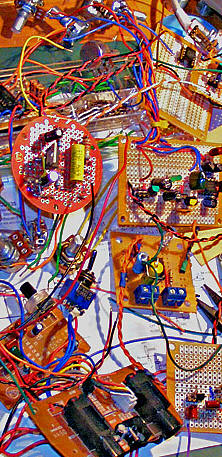
I have been working on a Beavis fuzz for six months now--an over-the-top successor to the original oldfuzzLab. During this time I've built a bench full of circuits and tried to weave them together in interesting ways.
All within the crippling tyranny of the stompbox form-factor. And the farther I got, the more depressing the whole project became. There were just too many compromises to make when trying to fit it into a stompbox.Although this project never reached completion, it got close enough to yield some interesting circuits and variations: Input buffer and splitter, Red Fuzz, Black Fuzz, PWM Fuzz, 567 Modulator, 555 Modifier, Drone Oscillators and a Sequencer VCF.
So if I can't win, why not change the rules? What if it doesn't have to be a pedal with a single in/out jack? What if I don't have to give a rat's ass about stompswitches? What if there aren't limits on the enclosure form factor?
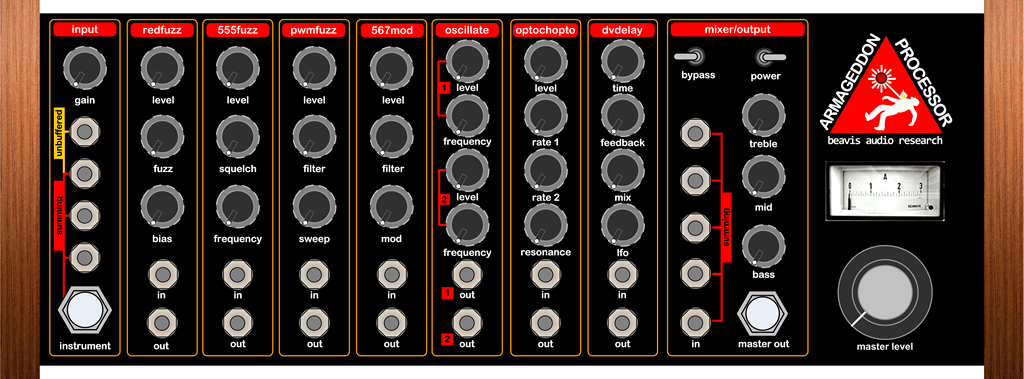
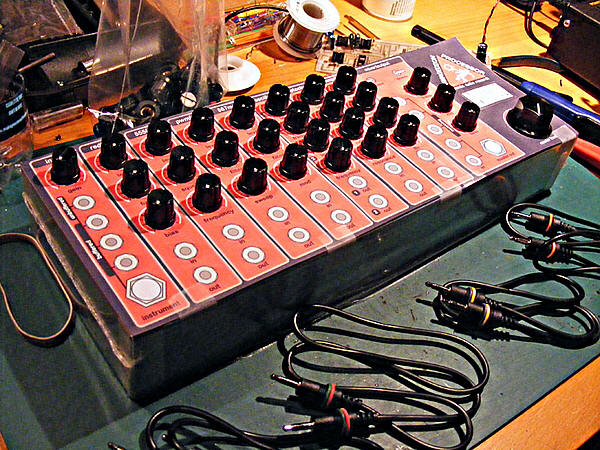
The result is the Beavis Armageddon Processor. This is not a stompbox--it is a fuzz/oscillator/sequencer that I can set on top of an amp and "play" in real-time, just as if it were an extension of the guitar, part of an overall, far more interesting quot;instrument." The Armageddon Processor borrows heavily from the concept of analog synthesizers, complete with patch points for banana jacks. The idea is that I can route any module to any other module in just about any order I want. And I can do it without rearranging shit on the pedalboard. I'd guess I'm about 70% done with the design so far.
Get on the Bus
Each of the modules has inputs and outputs, so it is rather like your pedalboard. But since it is implemented in a single box, it is a lot easier to patch things in and out--to change the order and feed different things into different things. You plug your guitar into the input, and from there you have 4 output points. This is where it differs a bit from a pedalboard. Instead of serial (a->b->c->d etc.) you can go from a->b and a->c and d->b etc. At the end of the box is a four channel mixer, so you can take the various outputs, sum them together, and control the level of each. The final stage is a master output knob, just like the master volume on a suitably equipped amp.
The design so far calls for banana jacks to fit into the analog synthesizer design motif. I'm not sure this will work since banana jacks/plugs are single wire. That means no grounding so I think the noise/gain issues may be a problem. If so, I'll switch to RCA/phono jacks.
The Modules
The Armageddon Processor is comprised of 9 discrete modules.
Input Buffer and Splitter
This is a simple JFET input buffer that goes into a clean boost based on the old Electro-Harmonix LPB-1 Linear Power Boost. The guitar input is buffered and then split off to four input points. These input points can then go on to various other modules in the box.
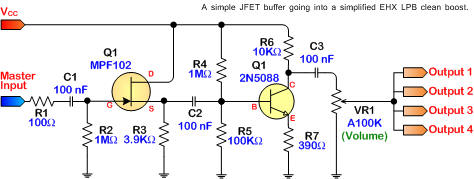
Buffer Splitter Schematic
Red Fuzz
A bog-standard Fuzz Face. The only mod is that I'm using NPN MPSA18 transistors and the traditional fixed bias resistor has been turned into a pot. I love the snarly nastiness of the Fuzz Face so it would have been crazy not to included it in a box centered around fuzz.
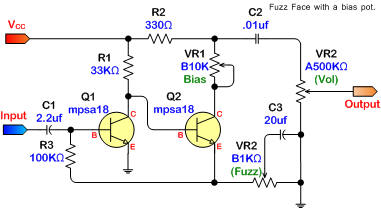
Fuzz Factory (Modified) Schematic
Black Fuzz
If I had to dedicate the work behind the Armageddon Processor to any single person, it would probably be Christian/Hemmo. He has one of the most offbeat DIY sites. It hasn't been updated in a long time, and it is ugly as hell as sites go, but his little snippets have gone a long way. The Black Fuzz is based on his single and double transistor designs. I put two of them back to back and added a filter.
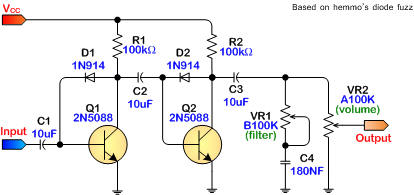
Modified Hemmo Fuzz
PWM Fuzz
Tim Escobedo's Circuit Snippets is one of the crown jewels of the DIY schematics world. He has so many designs that are different and thought-provoking. One of those is the PWM, a fuzz that is based on a Schmitt trigger. I modified this design to cascade an additional gate and added a filter control. Lovely.
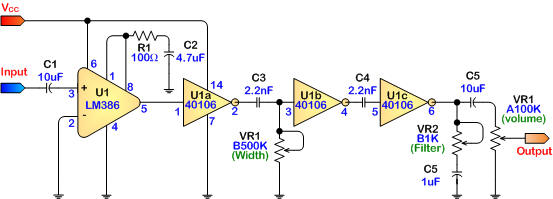
PWM Fuzz
567 Modulator
Another nod to hemmo/christian here. He had a couple of circuits based on the LM567 chip. This bizarre device was designed to help decode touch-tone frequencies on telephones. His hackage opened my eyes to this msytical device and I spent many hours at the breadboard trying all the possible permutations of what the 567 can do. I ended up with a modifier that can go from a choppy tremolo to a nasty ring mod at the twist of a dial.
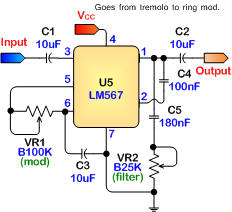
Hemmo 567 Modulator
555 Modifier
Like an idiot alchemist trying to turn lead into gold, I've spent a lot of time trying to get faux synthesizer tones out of a 555 timer. I've pored over John Hollis Crash Sync and Tim Escobedo's Uglyface. I have a binder full of nothing but 555 datasheets, schematics, ideas and what-nots. The end result is a slightly novel approach to using the 555 as an oscillator.
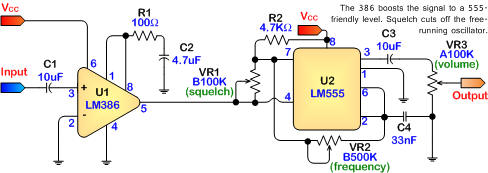
The 555 Modifier
Drone Oscillators
Many months ago I added a simple mixer and an opamp function generator to a big muff pi. The result was a tunable oscillator that I could riff along with. What could be better than a drone oscillator? Why, two drone oscillators of course. This simple design uses a 40106 Schmitt Trigger chip to create two tunable tone sources.
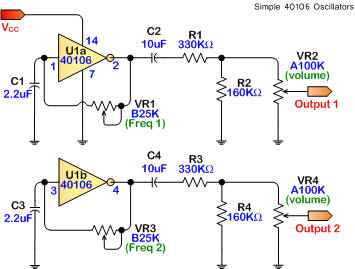
Schmitt Trigger Oscillators
Sequencer/VCF
This is probably the most exciting of the modules. It is an 8-step sequencer driving a voltage controlled filter. Again the 40106 is pressed into service as a LFO to pulse a 4017 decade counter. I found the idea for this from Bill Bowden's very bitchin' site in the form of a LED sequencer. I dispensed with the 555 timer LFO because it was noisy as hell and clicked and clacked. The VCF design is not finalized yet, so many choices to try there...
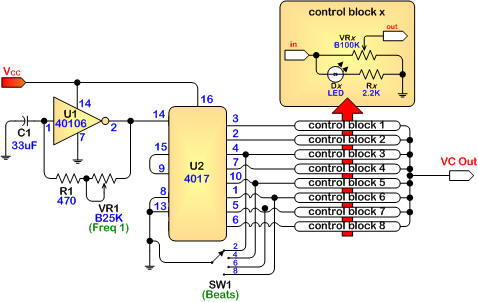
The Sequencer Thing
Output Mixer
This one is still in the design stages. It will be a buffered mixer, four inputs, a treble/mid/bass tone stack, and a master output.
Analog Delay???
It sure would be nice to add an analog delay to this box. Here's the thing though: I'll build an analog delay when monkeys fly out of my ass. Not that it wouldn't be cool to build an analog delay, but at some point this project actually has to end. So as a compromise, I'm toying around with the MODBoard Analog delay. Sounds pretty good so far, and at only 50 bucks for the populated/built/tested board, it just may be a feasible alternative.
Status and Pictures
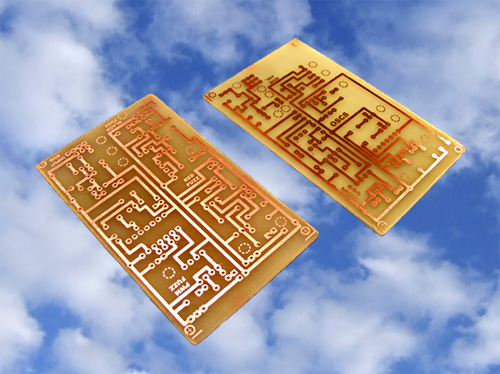
Got the first two PCBs done. On the left is the fuzz + input bus board, on the right is the the 567 mod, 555 mod and oscillators.
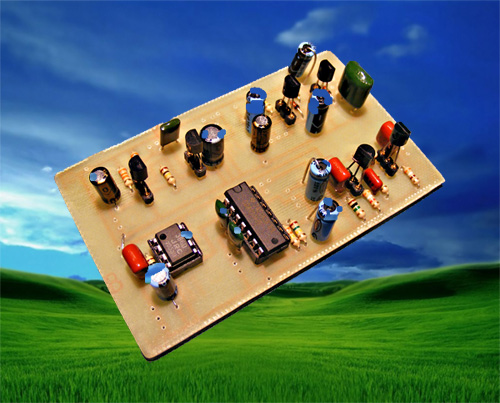
Fuzz board populated and ready to test
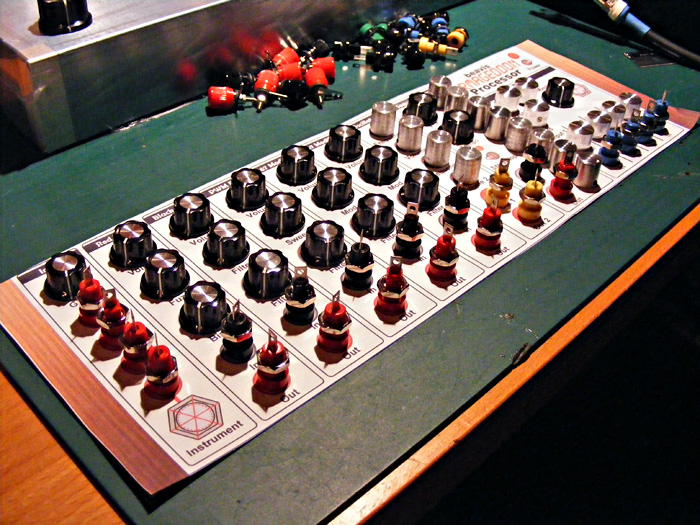
Front panel layout tests
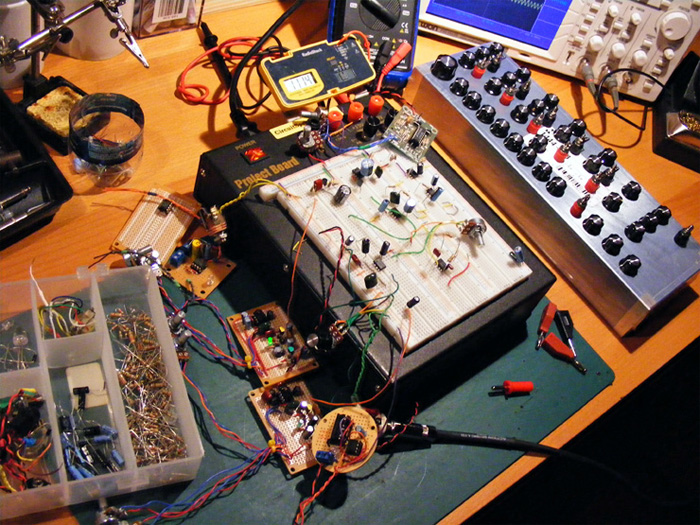
Big mess o' breadboard
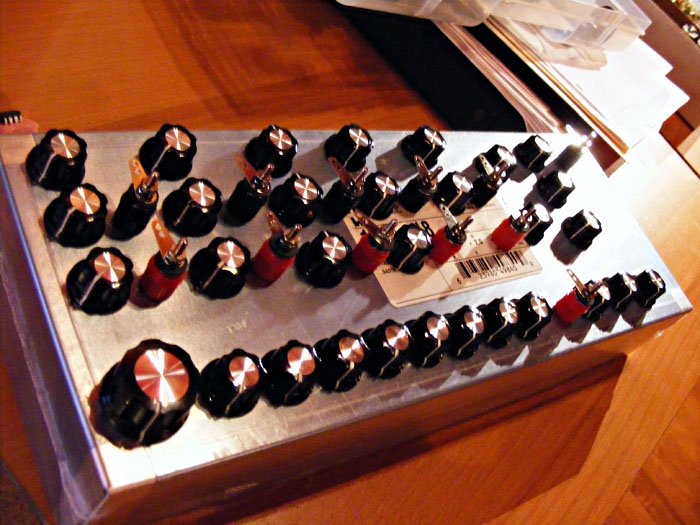
Too many knobs...
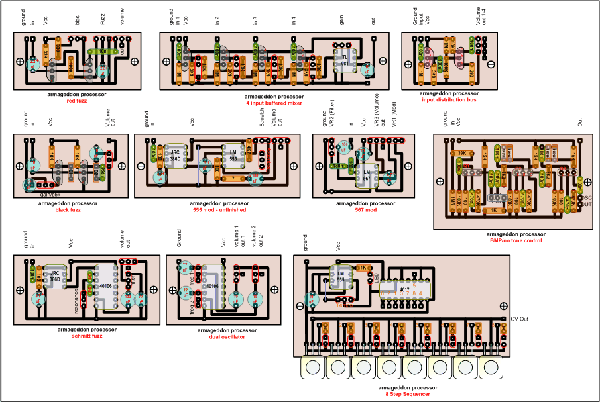
Working on the pcb layouts
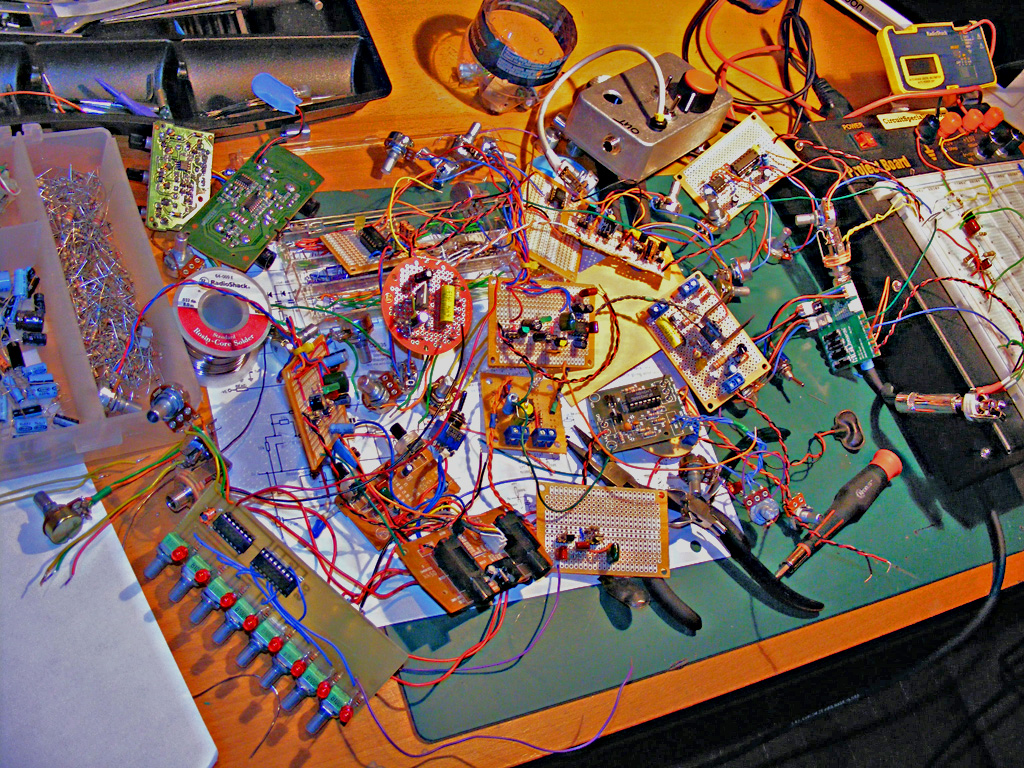
Mess o' prototype boards
More to come...
